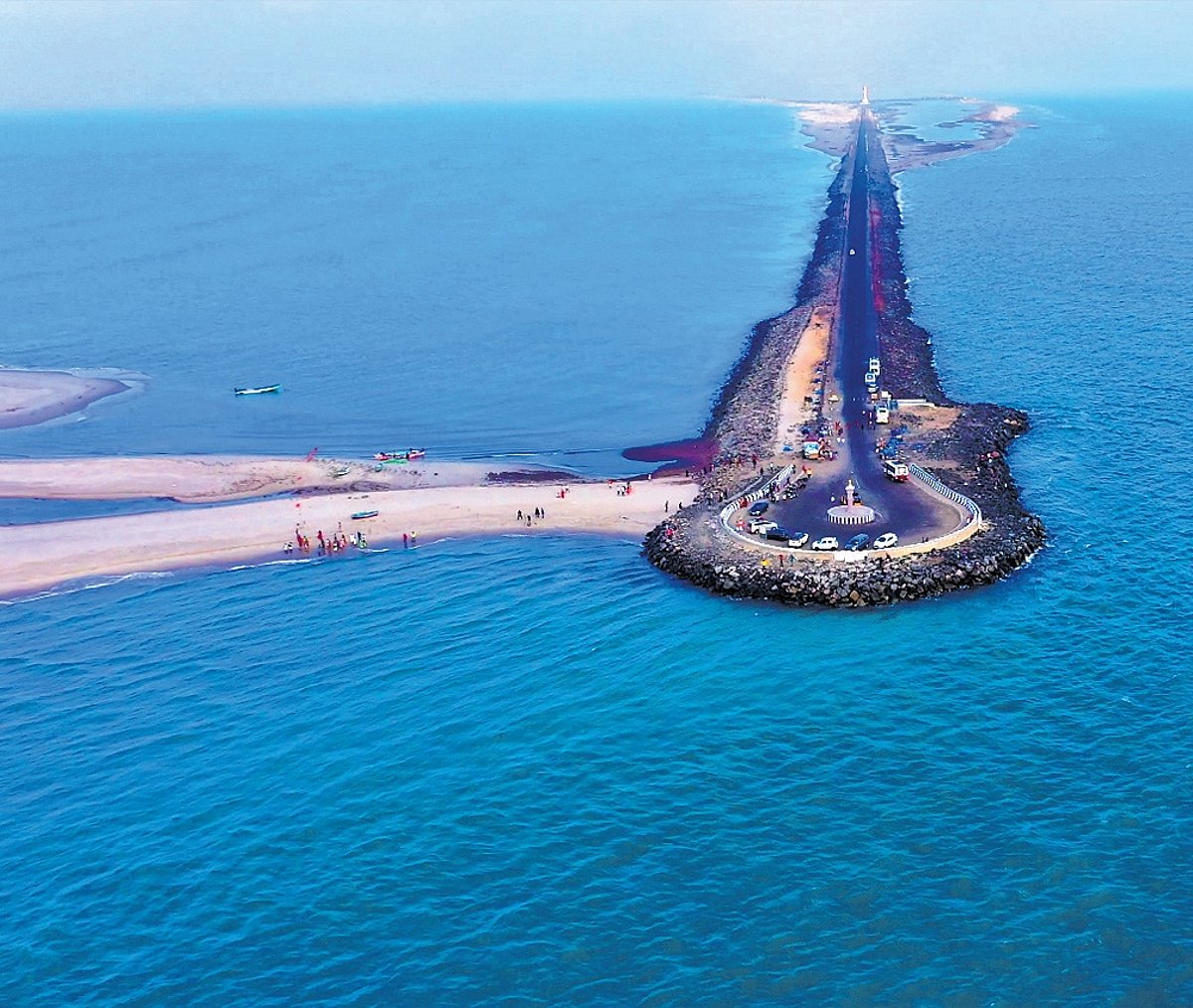
A little further on, Dhanushkodi, the ghost town, holds its own poignant allure to the tourist. The ruins of a church, remnants of a railway station and a sunken temple echo tales of the devastating cyclone of 1964. Yet, as the sun sets in a fiery blaze over the ocean, the stark beauty of the place softens its tragic past.
Here, the Bay of Bengal’s gentle backwaters meet the roaring waves of the Indian Ocean, a vivid spectacle of two seas colliding yet coexisting. Souvenir shops make brisk business as people throng to the venue to see where India ends geographically. During the day, fishermen haul their fresh catches to shore, where women in the makeshift shacks prepare charcoal-grilled fish, prawns and crabs—a sensory feast for the gourmands.
Travelling all the way to Rameswaram and not seeing the Ram Setu is a tourist crime. The Setu intrigues with its blend of faith and science: this 50km stretch of submerged limestone shoals, said to be Rama’s path to Lanka, stirs immense curiosity in all. ISRO’s satellite imagery hints at a lost land connection: the bridge that connected Pamban Island in India to Mannar Island in Sri Lanka until the 15th century when it was damaged by a cyclone.
For the inquisitive explorer, there are the volcanic limestone boulders displayed at the Panchamukha Hanuman Temple—floating merrily on water, defying gravity and logic. An endless stream of visitors flock to the Abdul Kalam Memorial—tribute to India’s ‘Missile Man’. With spacious interiors, interesting sculptures and well-maintained gardens it houses Kalam’s tomb, a curated museum with his pictures; miniature models of missiles; and his personal belongings including his veena.
Tucked away in the charming Kunthukal beach is the beautiful orange hued structure—Swami Vivekananda Memorial that houses a museum and an aquarium. The Hindu monk’s association with Rameswaram dates back to 1893 when he left from this shore to the US to deliver his historic speech in Chicago and returned to the same coast after four years.
Rameswaram is not just a destination; it is an experience. It connects the ethereal and the tangible, the ancient and the modern, leaving visitors with memories etched in awe and wonder.